Showing posts with label Linda K. Thomas. Show all posts

Monday, June 7, 2021

With only fond memories of the red plastic basin-turned-toilet-seat


Dave and I opened our eyes the next morning and looked around our little room, aided by a few glints of sunlight creeping in through rustic wooden shutters covering a tiny window opening (no glass). Our room was small—I mean, dinky. Miniature. (Later that day we measured our bedroom: seven feet square.)


But my first order of business was to hurry to the choo and empty my bladder.


The Mwakodis had no running water or toilet, only a pit latrine in a stick-and-mud enclosure some distance from their house. So, after slipping on a T-shirt, skirt, socks, and boots, I grabbed my roll of toilet paper and headed out across a clearing on the forested mountainside.


You might recall that I was not a big fan of pit latrines. (Click on I could envision how men could aim for that hole in the ground, but what about women?)


Stepping inside the Mwakodi’s pit latrine, I was overcome with fond, fond memories of . . . not past pit latrines, but of the red plastic basin-turned-toilet-seat that our friend Joy had made back in Maasai-land. Why hadn’t I thought to make one of my own for this phase of our orientation??


Even better would’ve been those outhouses with black toilet seats back at Naivasha. I should have appreciated them much more back then. Compared to pit latrines, they were things of beauty.


Our bed, three feet wide and five feet, seven inches long, had both a headboard and footboard. My husband, Dave, stands over six feet tall so that bed posed a problem, but he did what our orientation director, Brian, taught us—he developed a coping mechanism. He put a suitcase along his side of the bed and put one foot on it, and he spread-eagled the other foot across to the other corner of the bed.


That left me one corner in which to curl up.


That miniature room also housed two large storage barrels, a suitcase that belonged to Bwana and Mama Mwakodi, a chair with another of their suitcases, and our belongings—suitcases, backpacks, and canteens.


Bwana could speak Swahili and a little English, but Mama didn’t know English and didn’t speak Swahili much either. Apparently, she and Bwana talked to each other in the Taita language.


They served us a piece of bread and cups of tea for breakfast, always smiling, acting genuinely honored to have us in their home. What gracious folks they were!


And then Bwana said, “We will leave soon for church.”


And thus began the first day of our three-week stay with Bwana and Mama Mwakodi, three weeks packed with altogether new experiences, a number of challenges, and a chance to hang out with two of the nicest folks God ever created.


Our bedroom at the Mwakodis' home: 


Monday, May 24, 2021

The beginning of our biggest test yet


You remember those knot-in-your-stomach times when the rubber hits the road, when you know you’ll be tested and tried.


You had trained and studied and prepared, you had prayed and worried and prayed some more.


And the day came when you had to see for yourself

whether your training and preparation were enough—

whether your faith was adequate,

whether God was adequate,

whether you were adequate.


Well, that’s where Dave and I were—on the threshold of our big test—one that would last three weeks.


You see, we and our fellow orientees had been in training for two months and the time had come for us to see how well prepared we were for the third and final phase of our orientation: Each family would be on its own, scattered throughout remote African villages. We would no longer have the comfort of living alongside our fellow orientees. Our directors, Brian and Jenny, would leave the area.


But someone in our group needed to be in charge—in case of an emergency—so Brian called a meeting and had us vote.


Our fellow orientees chose Dave to be the Samaki kubwa, the big fish.


So, we all loaded up our tents and supplies and left Maasai-land. I remember our stay there as a mellow time, a serene time, a gentle time—for the most part anyway. I had enjoyed the quiet, the clean air, and the slow, simple lifestyle.


Our handful of vehicles headed toward the Taita Hills—a mountain range at an elevation around 7,000 feet—in southeastern Kenya, close to the majestic and famous Mt. Kilimanjaro. We left the desert and entered a lush, verdant region.


Before we all went on our separate ways on our own, our group congregated in Dembwa at the base of the Taita Hills, a small town close to a main highway and a bustling civilization. Town and regional officials welcomed us with lunch and speeches. And in good African style, both Dave and Brian gave speeches, too. (See photo below.)


We had gathered in the yard of a new elementary school with six or eight classrooms and, since Dave was an educator, he was curious about the classrooms. Since the children didn’t have classes that day, we stepped inside one room.


Concrete floors and walls kept the temperature nice and cool, but the school had no electricity—teachers and students depended on sunlight through windows.


The classroom was furnished with a slate blackboard and rough-hewn desks and stools.


A world map hung on the wall—the classroom’s only educational material.


The room had no textbooks, dictionaries, or anything else. In place of books, we noticed pencils and thin tablets in which children had written lecture notes from their teacher.


We found it hard to grasp the poverty displayed in that school—it seemed unthinkable—but we also knew the teachers, students, and their families placed a high value on education. They were doing the best they could with their meager resources.


On that day, little did we know that this school was superior to many others across the continent.


And so, with a knot in our stomachs

and with wonderings if we’d stand the tests,

and curiosity about what awaited us in the Taita Hills,

we were off on yet another adventure.

How good to know God was with us on it.

“The Lord Himself goes before you—ahead of you—

and He will stay with you.

He won’t leave you alone, He won’t forsake you.

Don’t be afraid. Don’t be discouraged.”

(Deuteronomy 31:8)


Dave and other speech-givers in Dembwa


Monday, May 17, 2021

Germs? Or angel dust?


It was one thing for us expatriates to sit around a table with other ex-pats and learn about respecting and valuing the culture new to us—and it was altogether another thing to live it out.


And so it was that one Sunday during our orientation course, Shel Arensen, a missionary with AIM (Africa Inland Mission), invited us to go to church with him and the Dorobo people. (You remember Shel—recently I told you about his novel, The Dust of Africa. I heartily recommend it!)


A few of us piled into Shel’s sturdy four-wheel-drive and we set out. Eventually the tarmac wore out, leaving just a lumpy, dusty track, but hakuna matata—no worries—Shel grew up in Africa. He patiently maneuvered the vehicle with ease—over, around, and through.


Eventually he pulled to a halt near the remote Dorobo village and we climbed out, a little nervous, wondering what awaited us.


A dozen people hurried down the hill to greet us with handshakes and broad grins.


Shy children looked up at us and then turned toward each other and giggled.


The adults spoke back and forth with Shel. We didn’t understand their language, but their smiles sent the message that they were pleased we had come.


Our new Dorobo friends led us up a dirt path toward their church. Along the way, children grabbed our hands and when they did, I heard the echo of our orientation director’s brief comment before we left camp. Brian had mentioned that some among the Dorobo have a reputation for poor personal hygiene.


Now, I’m a germ freak so when the children grabbed my hands, I wanted to pull away. At that moment, respecting and valuing the Dorobo culture seemed impossible.


But something—probably God—stopped me. Instead, with mixed emotions, I silently prayed the prayer my sister-in-law, Nancy, taught me, Oh, God, please cause my immune system to work well.


Shel told us the Dorobo Christians built their place of worship with pride and excitement and he led us inside it, a dim room about ten feet square, constructed of sticks and mud, with a dirt floor.


Under the corrugated tin roof, they had strung wires from corner to corner and had hung things on them—dried flowers, ferns, moss, squares of colored toilet tissue, and lined notebook paper on which someone had practiced penmanship.


On the walls, they had tacked pages out of European and American magazines—ads for coffee, pantyhose, and nail polish.


They’d built hand-hewn benches around the walls and when our group joined them, we packed that little room.


The Dorobo worshiped God with their songs, sometimes in Swahili, sometimes in Maa. They listened to Shel’s Bible stories and studied his pictures. He talked with them at length to be sure they understood the lessons and knew how to apply them to their lives.


Looking back on it now, I never imagined I’d visit a rural village or worship in a church like the Dorobo church, but I’m so glad I did.


On our drive back to our orientation campsite,

it occurred to me that despite the remote setting

and my germophobic tendencies,

the Dorobo people blessed us.


They welcomed us and invited us to worship God with them.

Nothing could be finer than that.


Cross-cultural living can have its “moments,”

but it can also lead us to discover joy, beauty,

and a richness we would miss otherwise.


Maybe the stuff on those children’s hands was angel dust.


Monday, May 10, 2021

Turning our American mindset upside down


Our three-month orientation course, called Kenya Safari, helped us make sense of our new settings, to adjust and flourish.


It equipped us and our fellow new missionaries to transition into the work we came to do.


And—this is crucial—our orientation taught us expatriates to respect and value the culture new to us—to learn Africans’ world views and social norms and values and expectations.


But we needed to go beyond just appreciating their ways of doing things: We needed to understand the importance of not offending the host country’s people—our new coworkers and neighbors. Our job was to respectfully model our behavior after theirs. We needed to fit in.


That required us to turn our American mindset upside down.

It required us to humble ourselves.


“Cultural humility gives up the role of expert,” writes Marilyn R. Gardner, “instead seeing ourselves as students of our host culture. It puts us on our knees, the best posture possible for learning. . . .


“Cultural humility demands self-evaluation and critique,” Marilyn continues, “constant effort to understand the view of another before we react. It requires that we recognize our own tendency toward cultural superiority” (Between Worlds, Marilyn R. Gardner; also posted on Facebook February 5, 2021).


We discovered that what is polite (or at least acceptable) in one culture could be rude in another. For example, Africans are people-oriented and Americans are not, and, in Kenya, everyone shakes hands when they say hello and goodbye. If we fail to do so, we insult them. Learning to always shake hands was important—and yet it was not easy for us Americans to remember. We had to be very intentional in order to not upset anyone.


Here’s another example of the difference between the way Americans and Africans think. You might have heard it—it’s making the rounds on Facebook. It’s a story illustrating “ubuntu,” the concept that “an authentic human being is part of a larger and more important relational, communal, societal, environmental and spiritual world” (African Journal of Social Work).


The story, which might or might not have come from Lewis Hyde’s The Gift, goes something like this:


A non-African anthropologist gathered a group of children around him after placing a basket of fruit at the base of a tree some distance away. He told them that when he gave the signal, they were to run to the tree, and he promised that the first to get there would win the fruit.

The anthropologist probably said something like, “On your mark. Get set. GO!”

But to his surprise, the children grasped hands, ran together to the tree, and sat down and shared the fruit.

The anthropologist questioned them: “Why didn’t one of you run ahead? You could have had all the fruit for yourself.”

“Ubuntu,” they replied. “How can one of us be happy if the others are sad?”


Sometimes ubuntu is translated “I am because we are,” or “is often used in a more philosophical sense to mean ‘the belief in a universal bond of sharing that connects all humanity.’” (Wikipedia)


The story was an eye-opener for the anthropologist. Similar stories from African cultures continue to baffle us Americans, too—although if we understood and applied the Bible’s teachings, I have a hunch we’d be more inclined to do what those African kids did.


Throughout our orientation course, we learned to:

listen,

observe,

stretch our thinking,

and, perhaps most important: scrutinize our assumptions.


We had frequent opportunities to stand back and examine our American ways, including our American Christian ways.


And many times the African way seemed better than ours.

We had much to learn from Africans.


Monday, May 3, 2021

An American learning how to eat in Africa


We cooked meals over an open fire alongside our narrow, shallow stream in the desert at a place you can’t find on the map.


There in southwestern Kenya, among the Maasai, for six weeks fifty of us camped in tents, counting orientees, children, and staff.


Our crew had set up the kitchen tent and cooking fire under fig trees, to take advantage of their shade, but baboons overhead threw figs at us. Our Kenyan staff hollered to drive them away, but they sat there with defiance in their eyes and kept pelting us.


One morning while I crouched beside the fire, cooking breakfast for our group, a baboon up in a tree pooped into the pot of food. I threw the whole thing out and began again.


“Can God spread a table in the desert?” the Israelites grumbled against God (Psalm 78:19). Yes, He gave them manna in their desert, and He gave us chapatis in ours—round, flat, bread-like, and fried in lard. Unleavened, and with a dense, rubbery consistency, chapatis are a staple throughout Kenya.


God also gave us ugali, a thick, stiff porridge of white cornmeal. We Americans found it flavorless because Kenyans don’t put salt or sugar in it, but they love it and eat large mounds a couple of times a day.


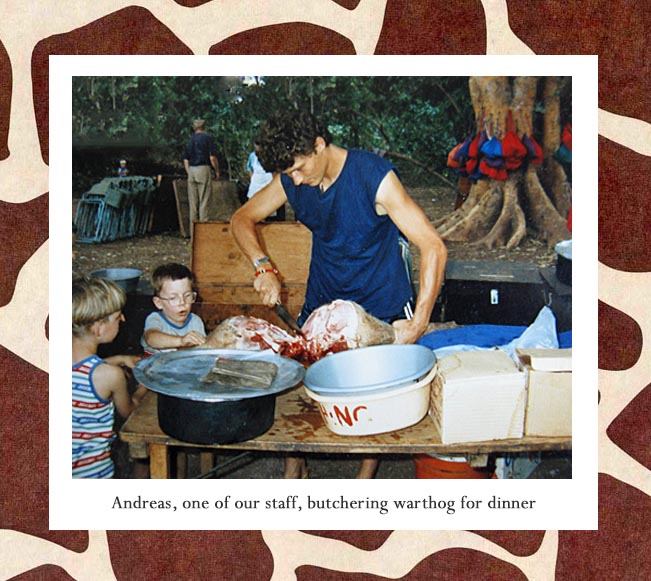
We also sampled dik-dik, ostrich eggs—one equals ten chicken eggs—and warthog, a gift from our Maasai friends who shot it with bows and arrows. It tasted delicious, tender and moist.


We learned hands-on things like how to soak vegetables and fruit in bleach-water to kill amoebas and other critters that could have made us really, really sick.


Our menu also included Marmite (sometimes called Vegemite, depending on the continent), a dark brown sticky substance the Brits and New Zealanders among us spread on their bread and butter. They were wild about it, but we Americans found it nasty.


And lest anyone believes that when a hen lays eggs, they look just like they do when we buy them at our North American supermarkets—No way! Before we cracked our eggs, we washed off straw, poop, and an occasional feather, and—since people didn’t refrigerate eggs and there was no such thing as a “use by” date—we tested them for freshness. We poured water into a container and dropped an egg in; a fresh egg would sink to the bottom, but a spoiled egg would float.


Our dining room, which adjoined the kitchen tent area under the trees, consisted of wooden folding tables and canvas safari chairs. I used both hands to eat. One hand navigated a fork, the other waved above my plate to protect it from flies, figs, and baboon droppings from above.


We also learned that what we call Jell-O is called “jelly” in Africa. And what we call jelly, Africans call “jam.” How confusing for us Americans!


Hamburger is called “mince.”


French fries are called “chips.”


Potato chips are called “crisps.”


Zucchinis are called “corgettes.”


Green peppers are called “capsicum.”


And corn is called “maize.”


Oh, dear . . . . We had so much to learn!


Monday, April 12, 2021

Running my fingers through a psychiatrist’s hair


During our three-month orientation to living well in Africa, we learned practical, hands-on things like how to soak vegetables and fruit in bleach-water to kill amoebas and other critters.


We also learned to drive The Pearl. Ah, The Pearl. I haven’t told you yet about The Pearl of Africa, a 1974 Toyota Land Cruiser, perfect for travel in Africa.


Our director, Brian Caston, taught us to drive it across deserts and through streams and showed us how to change punctured tyres. He trained us to note our surroundings when we traveled and to remember key markers, such as a tree or dwelling, to help us find our way back to camp.


Brian also taught us to develop coping mechanisms—things that ease frustrations and make life manageable. For example, the twig shelves Dave made for our tent were coping mechanisms—they allowed us to unpack our luggage for six weeks and stay organized.


Do you remember how our friend Joy turned an upside-down basin into a makeshift toilet seat? That was also a coping mechanism. Developing coping mechanisms can make the difference between staying on the mission field or giving up and going home.


We also learned practical things such as how to sanitize the choo (outhouse) with ashes from our cooking fire.


And we learned how to cut hair. One day I helped my friend Nancy cut her psychiatrist-husband’s hair. Never in my wildest dreams could I have guessed I’d one day run my fingers through a psychiatrist’s hair.


One day Brian loaded us into The Pearl and another vehicle and we drove around the vast Maasai territory. We stopped in a remote, dusty, parched town, but it seemed like a lively city compared to our campsite, Eleng’ata Enterit. I spotted a man there who wore a tattered, faded T-shirt advertising Spokane’s famous Bloomsday Race—Spokane, Washington, my birthplace. We just never know where our thrift shop donations might end up.


We motored on and came to a stream and, since the temperature felt like a hundred degrees, people begged Brian to let them go swimming. He said they could but warned that the water might have microorganisms that make people sick.


A few people wanted to swim anyway, and they scouted around for a private place to change clothes—except for the Dutch family. They walked a short distance away and changed where anyone could see.


And oh, yes, critters did live in that stream and they made those swimmers sick, sick, sick for several days. Our nurse, Jenny Caston, and her trunk of medicine blessed us richly at such times.


I know first-hand how important Jenny and her meds were because while we camped at Eleng’ata Enterit, I got a urinary tract infection. I knew how serious those infections could become, so I shot prayers heavenward and God answered through Jenny and her antibiotics.


The meds kicked in immediately, yet I knew, too, that I had to avoid dehydration under that equatorial sun. On one afternoon, I knew I had to lie down.


There on my back, I watched a tiny insect crawl up our tent wall. It climbed higher and higher, but when it got to within a foot of the top, it flew off the wall and screamed in wild little circles. After ten seconds of this, it landed back on the wall, several feet lower than before.


Again, it climbed higher but, within sight of the top, it tore into its screaming fits and landed low on the tent wall.


For fifteen minutes, I watched that little critter repeat its self-defeating behavior. I cheered him on and urged him not to have a meltdown and give up. He had climbed so close to the top!


I wanted to tell him the hardest part was behind him and if he could just hold on for a few more seconds, he’d reach his destination. But no, he always gave up just before he reached his goal.


Sometimes we humans do the same thing. Impatient and weary, we don’t realize how close we are to success and we give up and indulge in wild fits, and by the time we get back in focus, we’ve lost ground.


By God’s grace, our orientation course was aimed at helping us sort all that out. And it was good, so good. (From Grandma’s Letters from Africa, Chapter 2)

Brian and Jenny Caston, dear folks!


Monday, April 5, 2021

Our Maasai guard’s prayers for us brought tears to my eyes


. . . Dave and I bent down—the doorway opening was miniature—and stooped inside the home of our Maasai guard, John.  


Suddenly blackness enveloped me, and I caught my breath. Outside, we had stood in intense equatorial sunshine, but when I ducked through that little door, the sheer darkness shocked me.


Immediately I received another surprise: in front of me, within about two feet of the doorway, I came face to face with a wall.


I jerked backward, ever so slightly, back toward the light. . . . (Click on My heart still races when I remember those moments.)


I must have gasped because Dave took my hand and led me to the right. We felt our way down a short hallway and entered a small room, also dark except for a tiny hole in the roof—about four inches across—to let smoke escape.


Little sunlight entered through that hole.


Everything appeared dark—mud-colored dung walls, dirt floor, and smoke-covered ceiling. (I realized then that’s why the Maasai, their possessions, and artifacts always smell of smoke).


Gradually my eyes adjusted to the dark and I could see that the room measured about nine feet square. Some of our fellow orientees sat on beds—wooden frames attached to two walls, with loosely woven strips of cowhide for mattresses. I joined others who sat on a low, rough-hewn bench attached to John’s dung-mud-and-stick wall. We had entered the heart of that Maasai family’s world. 


A small pile of coals burned on the floor in a fire pit made of three stones. In the shadows, I noticed a couple of children and one of John’s three wives. He had children by all of his wives, and each family unit lived in its own hut within the compound. Apparently, John took turns living in each hut.


Our Maasai hosts had invited us for tea, and John’s wife squatted on the dirt floor over the fire where, in a large metal pot, she boiled milk, water, tea, and sugar together—that’s what they called chai.


Two things worried me about their chai, though, because they made it with water from the same dirty little brook that flowed beside our campsite—where animals waded, where people bathed and did laundry.


Second, I worried because I heard that Maasai clean their pots with cow urine and charcoal. This germ-phobic woman found the situation stressful. The primitive setting, the dwelling, the smoke-filled room, the furnishings—everything seemed alien. My nerves were on edge.


But then. . . . But then. . . .


When the chai was ready,

John prayed for us, in English and, to my surprise,

he prayed only for us. On and on he prayed,

asking God to shower His blessings upon us.

Only a man well acquainted with God

could pray the way John did.

His prayer brought tears to my eyes.


John’s wife poured the chai through a strainer into a metal teapot, and then John took over. First, he poured the chai into a metal cup and then into other metal cups—the kind with a rolled rim—and began to pass them around to his guests.


Our orientation leader, Brian, had warned us about those cups. Washed in water from the stream, the rolled rims could trap that filthy water. Since we couldn’t know how clean the cups were, Brian coached us ahead of time to pour some chai over the rim—as inconspicuously as possible—and hope it was hot enough to kill germs where we put our lips.


So, there in the dark, each of us reached down and dumped chai on the ground. I wonder if our hosts noticed—they probably did—and I wonder what they must have thought about us.


The room had no cross-ventilation and sweat ran down my back and neck. We visited for about an hour—John and Brian apparently conducted introductions and made speeches in Swahili—and then we hiked back to camp.


Along the way, I pondered how John and his family

lived in what Westerners would consider poverty,

and yet they were rich in hospitality, dignity, and the love of God.


I had worried about manure, soot,

cow urine, and contaminated water,

but in reality, I had stood on holy ground.

God lived in that place.

(From Grandma’s Letters from Africa, Chapter 2)


Now I look back and realize that John and his family were part of the “hundred times as much” God provided in answer to Karen’s prayer (click on When Jesus’words are difficult, sharp, and real.)

Our shallow little stream in the desert


Monday, February 15, 2021

When Jesus’ words are difficult, sharp, and real


“Love is unselfishly choosing for another’s highest good.” 

C.S. Lewis


Continuing from last week with our guest blogger, my precious daughter Karen:


I remember helping my parents pack their treasures away that summer and moving out of the house I’d grown up in.


I was attached to that house, to those books, and dishes, the creaks in the hallway floor, the smell of the spices in the cupboards, the view from the kitchen table of the walk outside the front door, the basketball hoop above the garage door, and the cracks in the driveway we used for the free-throw line.


Moving out was hard for my mom especially, although I think she tried not to show me.


I read the gospel of Matthew that summer and many of Jesus’ words were difficult, sharp, and real, and I was challenged to ask myself if I really believed them—did I take Jesus at his word? Both the difficult words and the comforting words?


My parents were taking him at his word. They were throwing everything they had into his care, against common sense, outside their comfort zones.


My self-centered sadness was tempered by deep admiration, and a desire to trust God and live accordingly, like they were doing. I was learning, slowly, that with my eyes on God, I could view change as adventure instead of loss.


That summer I accepted my first teaching job and my dad helped me find a little house to buy, both of which were equally thrilling and terrifying. The excitement of those upcoming transitions, of my entrance into the adult world, with all my optimism and 21-year-old confidence, helped some, but also made their departure more difficult. I entered these new roles without the comfort of knowing that I could fall back on my parents’ guidance and help.


God’s greatest gift to me had always been

the love and support of my parents.

They had been the sigh and deep breath of knowing

I had backup—they’d been there for me no matter what.

I’d always known I’d make it because,

well, because Mom and Dad were there.

My Great-grandpa Mac had assured my Grandma Kay,

“You can always come home,"

and that’s the kind of parents I had.


But with them in Africa, I couldn’t just make a phone call or stop by for an infusion of confidence and encouragement. I was learning that God Himself would be my support and that He was enough.


The night before my parents left, I remember crying. And I remember my mom crying—the only time I specifically remember her crying. Her grief was tangible. It was as if I could actually feel her heart breaking.


We of course had talked about our sadness, about her worries of leaving me, about the difficulties, about trusting God, but that night it was as if I couldn’t reach her. Words and hugs weren’t enough. She was isolated in her sadness, and I suppose I was too, and both of us were trying to think of the other.


I remember opening my Bible later and, not to overstate it, but it was like an epiphany. Words I’d read before suddenly were clear and true and alive:


“And everyone who has left houses

or brothers or sisters

or father or mother or children

or fields for my sake

will receive a hundred times as much

and will inherit eternal life.”

(Matthew 19:29)


That’s what my parents were doing. They were following Jesus. It was suddenly so beautifully clear to me that that’s what it is all about, and if we are doing that, nothing can go wrong.


It might not go the way we expect,

and it might hurt,

it might even break our hearts,

but we would be all right

because God was with us and we were trusting Him.


I remember thinking I needed to trust God for the promise in that verse, both for me and for my parents: that we would receive a hundredfold.


I prayed that for my mom that night. I asked God to give her a hundredfold for all her sadness, for all she was leaving behind. I remember writing the verse down to give to her. I wanted her to know that I understood, that I trusted God, that I believed Him and His promises—for myself and for her.


By now, friends, you understand why Karen is so dear to me and why my heart broke to leave her.


Come back next for Karen’s third and final post.