Showing posts with label Grandma’s Letters from Africa. Show all posts

Monday, August 9, 2021

Mama forgot the spoons!


The members of our orientation group lived in villages scattered throughout the Taita Hills. Dave and I lived at the highest and remote location of all.


Our host family, Bwana and Mama Mwakodi, didn’t live in a village. Their house seemed to be the only one around and it measured about twenty feet wide and twelve feet deep.


Inside, they had painted their mud-plaster walls aqua blue. Over time, patches of mildew had stained the walls. And their cement floor crumbled in places. Ah, but their home was full of love and grace!


The main room had one small window opening—no glass—with a shutter of unpainted planks. The Mwakodis kept it closed so the house remained dark except for sunlight that came in the wood-plank front door.


That room reminded me of the Dorobo church we visited in an earlier segment of our orientation: The Mwakodis had strung wires from corner to corner under a corrugated tin roof, where a ceiling might have been, and from the wires they had hung papers and greeting cards.


Mama (Mrs. Mwakodi) always served tasty soup for the evening meal—cabbage, tomatoes, onions, kidney beans, a lot of water, and sometimes a few chunks of tough meat. She spent several hours each afternoon simmering this soup over the fire.


Mama also spent a long time making chapatis—round, flat, bread-like, and fried in lard. Unleavened, and with a dense, rubbery consistency, chapatis are a staple throughout Kenya.


One day I watched Mama make them and learned there’s an art to it. She mixed the flour dough and rolled it out like a round piecrust, layering lard into it.


Next, she cut slits around the dough so that it resembled a flower with petals. Mama folded each petal-like piece at an angle over the one beside it and toward the middle of the circle, and then rolled out the dough again.


She did this several times before frying them in lard over the fire. It took a long time to make them properly.


When we sat down to eat on our first evening in their home, I noticed Mama forgot to put spoons on the dinner table, but I decided to say nothing. Surely, in a few seconds Mama would realize her oversight.


While I waited and watched, Bwana and Mama tore their chapatis into pieces, dropped them into their soup, and then used their fingers to pick up one bite after another.


I could hardly believe my eyes.


I had no choice but to do likewise.


Apparently, white people need a lot of practice to perfect that skill.


On the third evening, I asked Bwana and Mama if I could use a spoon. They didn’t seem offended, so Dave asked for one, too.


From then on, both of us took great pleasure in the luxury of eating with a spoon. (From Grandma’s Letters from Africa, Chapter 3)


Monday, June 21, 2021

Have you ever felt clueless, cut off from God and His Word?


You might be asking, why did you move to Africa?


Well, Dave and I had lived in Africa for only a few weeks when we had a vivid, eye-opening experience that reminded us why we’d taken jobs in Africa.


For the first time in our lives, we experienced 

what millions of people experience around the world:


Without a Bible in a language they understand, 

throngs and masses of people 

walk out of their churches, week after week, year after year, 

with little or no understanding of Scripture readings 

or their pastor’s sermon.


Without Scriptures in their own languages, 

many multitudes can’t personally know or experience God 

and His love and grace.


Remember what I told you last week: Dave and I attended a very rural church on our first day of the “village living” segment of our three-month orientation.


There high in the Taita Hills, I’m certain no white people had ever visited their church before (and maybe never again since then).


Dave and I sat on hand-hewn plank benches for a three-hour worship service—understanding nothing anyone said. I suspect people spoke Swahili in their prayers, hymns, and Bible reading, but I had a hunch they spoke to each other in the Taita language. Perhaps the sermon was in the Taita language, too.


Whatever language they spoke, the local people understood. They worshiped God and took in the sermon in languages that spoke to their hearts—but Dave and I were clueless. We had no idea what the Scripture reading was, what the song lyrics were, what the people prayed about, or what the pastor said in his sermon.


I had known in theory why people needed Scriptures in their own languages, but that day I personally experienced what it’s like to have no Bible in a language I understood. God used that experience to drive home the importance of Bible translation, and we stepped out of church that morning with renewed enthusiasm for the jobs that awaited us after our orientation course.


You see, we moved to Africa to work with Wycliffe Bible Translators, a mission agency with a vision to provide each man, woman, and child with God’s Word in their own language—the language of their heart, the language they understand best. The language in which they speak words of endearment to their beloveds. The language in which they sing lullabies to their babies. The language in which they dream and hope and pray.


Having Scriptures in their own language makes it possible for them to experience God, love Him, communicate with Him, and serve Him. God and His Word have the power to transform. They can make all the difference for them on earth and for eternity. (From Chapter 3, Grandma’s Letters from Africa.)


What about you? 

Have you ever thought about what it would be like for you, 

personally, to have only the original Hebrew 

and Greek versions of Scriptures? 

Or to live in a foreign land and have Bibles 

and worship services in a language you don’t understand well?

Imagine how different your life would be 

without Scriptures you could understand 

in your heart and mind. 

Think of specific ways the Bible’s message 

has changed your life.


Give it some thought, and then thank God for your Bible in your language!


Monday, June 14, 2021

We had lived in Kenya only a few weeks and—Wham!


Early the next morning, while I was outside on my little trip to the choo (outhouse), I took in more of our surroundings, seeing what was hard to see the night before in the dark. The Mwakodis’ house sat on a little peak surrounded by forest. They didn’t live in a village—their house seemed to be the only one around. A narrow dirt trail passed by in front of the house.


Our first full day with Mwakodis was a Sunday and, as Bwana had told us the night before, we would be heading to church.


Bwana and Mama put on their one set of fine clothes. Dave and I had only the camping gear we’d brought on our orientation course, so I wore a denim skirt, T-shirt, socks, and hiking boots. Kenyan men seldom wore short pants so Dave wore long trousers and a button-down shirt with a tie.


When the four of us walked out the door, Bwana said, “We will take the vehicle.”


You’ll remember that our orientation directors, Brian and Jenny, by design, had left our group of orientees on our own and that Dave had been elected our group’s point man, someone to be our spokesman or advocate during those three weeks, the go-to person if anyone had trouble. With that responsibility, Dave also was given The Pearl of Africa, the group’s old Toyota Land Cruiser, to use for official business, not our own convenience. We were supposed to experience this last phase of orientation in the same way as the others in our group, which meant we were supposed to walk everywhere like everyone else.


So when Bwana said, “We will take the vehicle,” Dave and I knew that wasn’t a good idea. Dave said,  “No, we can walk.”


Bwana, who didn’t understand why we had The Pearl, smiled and repeated, “We will take the vehicle.”


Dave and I looked at each other briefly and somehow communicated with our eyes: This was Bwana’s home and we were his guests. This was Bwana’s territory and we’d better do things his way. So we drove.


We meandered among the forested hills for three miles on a narrow dirt track. The Taita Hills reminded me of the place we’d lived for the previous fourteen years: the Olympic Mountains and their foothills near Port Angeles, about the same elevation and covered with green.


Tropical plants grew in the Taita Hills—papaya, citrus, and banana trees—but I also spotted plants that grew back home in the Pacific Northwest: bracken ferns, purple lobelia, berry vines, pine trees, and cedar.


We came to a small clearing in the forest and spotted the Anglican Church, a small stick-and-mud/plaster building, the same color as the earth.


Bwana and Mama led us to the door and when we stepped inside, we interrupted the children’s class. I’m pretty sure we were the first white people ever in their church (and maybe the last) and we wazungu caused a stir—I mean a big stir.


Each little face turned our direction. Their song leader scurried to regain the children’s attention. Eventually, she convinced them to sing a couple more songs, though they turned and watched us while they sang.


I loved hearing the children sing. Their voices filled the room—a sharp contrast to so many Sunday school children back home who rarely sing louder than a whimper.


In the break between Sunday school and the church service, people welcomed us with courtesy, but we knew they found us curious—and very white—beings. For the first time in my life, I found myself a member of the minority race.


For the three-hour worship service, we sat on hand-hewn plank benches. The congregation spoke Swahili in their prayers, songs, and Scripture readings, but I suspect they spoke the Taita language in conversations and the sermon.


I had no idea what people said. For all I knew, the pastor might have preached in Chinese.


Dave and I had lived in Kenya only a few weeks and—

Wham!

God gave us a first-hand experience

like that of millions of people around the world,

week after week, year after year.

Without a Bible in a language they understand,

they walk out of their churches

with little or no understanding of Scripture readings

or their pastor’s sermon.

I had known this in theory,

but that day I personally experienced

why people need Bibles in their own languages—

and why we came to Africa:

to help with the work of Bible translation.


Monday, June 7, 2021

With only fond memories of the red plastic basin-turned-toilet-seat


Dave and I opened our eyes the next morning and looked around our little room, aided by a few glints of sunlight creeping in through rustic wooden shutters covering a tiny window opening (no glass). Our room was small—I mean, dinky. Miniature. (Later that day we measured our bedroom: seven feet square.)


But my first order of business was to hurry to the choo and empty my bladder.


The Mwakodis had no running water or toilet, only a pit latrine in a stick-and-mud enclosure some distance from their house. So, after slipping on a T-shirt, skirt, socks, and boots, I grabbed my roll of toilet paper and headed out across a clearing on the forested mountainside.


You might recall that I was not a big fan of pit latrines. (Click on I could envision how men could aim for that hole in the ground, but what about women?)


Stepping inside the Mwakodi’s pit latrine, I was overcome with fond, fond memories of . . . not past pit latrines, but of the red plastic basin-turned-toilet-seat that our friend Joy had made back in Maasai-land. Why hadn’t I thought to make one of my own for this phase of our orientation??


Even better would’ve been those outhouses with black toilet seats back at Naivasha. I should have appreciated them much more back then. Compared to pit latrines, they were things of beauty.


Our bed, three feet wide and five feet, seven inches long, had both a headboard and footboard. My husband, Dave, stands over six feet tall so that bed posed a problem, but he did what our orientation director, Brian, taught us—he developed a coping mechanism. He put a suitcase along his side of the bed and put one foot on it, and he spread-eagled the other foot across to the other corner of the bed.


That left me one corner in which to curl up.


That miniature room also housed two large storage barrels, a suitcase that belonged to Bwana and Mama Mwakodi, a chair with another of their suitcases, and our belongings—suitcases, backpacks, and canteens.


Bwana could speak Swahili and a little English, but Mama didn’t know English and didn’t speak Swahili much either. Apparently, she and Bwana talked to each other in the Taita language.


They served us a piece of bread and cups of tea for breakfast, always smiling, acting genuinely honored to have us in their home. What gracious folks they were!


And then Bwana said, “We will leave soon for church.”


And thus began the first day of our three-week stay with Bwana and Mama Mwakodi, three weeks packed with altogether new experiences, a number of challenges, and a chance to hang out with two of the nicest folks God ever created.


Our bedroom at the Mwakodis' home: 


Monday, May 17, 2021

Germs? Or angel dust?


It was one thing for us expatriates to sit around a table with other ex-pats and learn about respecting and valuing the culture new to us—and it was altogether another thing to live it out.


And so it was that one Sunday during our orientation course, Shel Arensen, a missionary with AIM (Africa Inland Mission), invited us to go to church with him and the Dorobo people. (You remember Shel—recently I told you about his novel, The Dust of Africa. I heartily recommend it!)


A few of us piled into Shel’s sturdy four-wheel-drive and we set out. Eventually the tarmac wore out, leaving just a lumpy, dusty track, but hakuna matata—no worries—Shel grew up in Africa. He patiently maneuvered the vehicle with ease—over, around, and through.


Eventually he pulled to a halt near the remote Dorobo village and we climbed out, a little nervous, wondering what awaited us.


A dozen people hurried down the hill to greet us with handshakes and broad grins.


Shy children looked up at us and then turned toward each other and giggled.


The adults spoke back and forth with Shel. We didn’t understand their language, but their smiles sent the message that they were pleased we had come.


Our new Dorobo friends led us up a dirt path toward their church. Along the way, children grabbed our hands and when they did, I heard the echo of our orientation director’s brief comment before we left camp. Brian had mentioned that some among the Dorobo have a reputation for poor personal hygiene.


Now, I’m a germ freak so when the children grabbed my hands, I wanted to pull away. At that moment, respecting and valuing the Dorobo culture seemed impossible.


But something—probably God—stopped me. Instead, with mixed emotions, I silently prayed the prayer my sister-in-law, Nancy, taught me, Oh, God, please cause my immune system to work well.


Shel told us the Dorobo Christians built their place of worship with pride and excitement and he led us inside it, a dim room about ten feet square, constructed of sticks and mud, with a dirt floor.


Under the corrugated tin roof, they had strung wires from corner to corner and had hung things on them—dried flowers, ferns, moss, squares of colored toilet tissue, and lined notebook paper on which someone had practiced penmanship.


On the walls, they had tacked pages out of European and American magazines—ads for coffee, pantyhose, and nail polish.


They’d built hand-hewn benches around the walls and when our group joined them, we packed that little room.


The Dorobo worshiped God with their songs, sometimes in Swahili, sometimes in Maa. They listened to Shel’s Bible stories and studied his pictures. He talked with them at length to be sure they understood the lessons and knew how to apply them to their lives.


Looking back on it now, I never imagined I’d visit a rural village or worship in a church like the Dorobo church, but I’m so glad I did.


On our drive back to our orientation campsite,

it occurred to me that despite the remote setting

and my germophobic tendencies,

the Dorobo people blessed us.


They welcomed us and invited us to worship God with them.

Nothing could be finer than that.


Cross-cultural living can have its “moments,”

but it can also lead us to discover joy, beauty,

and a richness we would miss otherwise.


Maybe the stuff on those children’s hands was angel dust.


Monday, May 3, 2021

An American learning how to eat in Africa


We cooked meals over an open fire alongside our narrow, shallow stream in the desert at a place you can’t find on the map.


There in southwestern Kenya, among the Maasai, for six weeks fifty of us camped in tents, counting orientees, children, and staff.


Our crew had set up the kitchen tent and cooking fire under fig trees, to take advantage of their shade, but baboons overhead threw figs at us. Our Kenyan staff hollered to drive them away, but they sat there with defiance in their eyes and kept pelting us.


One morning while I crouched beside the fire, cooking breakfast for our group, a baboon up in a tree pooped into the pot of food. I threw the whole thing out and began again.


“Can God spread a table in the desert?” the Israelites grumbled against God (Psalm 78:19). Yes, He gave them manna in their desert, and He gave us chapatis in ours—round, flat, bread-like, and fried in lard. Unleavened, and with a dense, rubbery consistency, chapatis are a staple throughout Kenya.


God also gave us ugali, a thick, stiff porridge of white cornmeal. We Americans found it flavorless because Kenyans don’t put salt or sugar in it, but they love it and eat large mounds a couple of times a day.


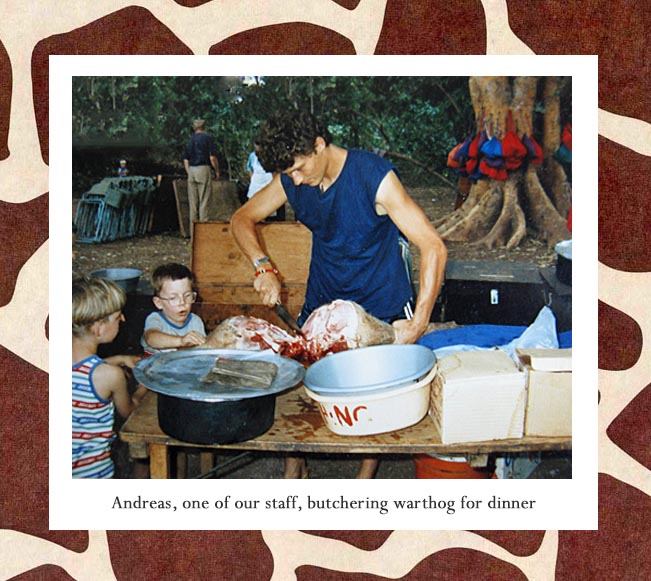
We also sampled dik-dik, ostrich eggs—one equals ten chicken eggs—and warthog, a gift from our Maasai friends who shot it with bows and arrows. It tasted delicious, tender and moist.


We learned hands-on things like how to soak vegetables and fruit in bleach-water to kill amoebas and other critters that could have made us really, really sick.


Our menu also included Marmite (sometimes called Vegemite, depending on the continent), a dark brown sticky substance the Brits and New Zealanders among us spread on their bread and butter. They were wild about it, but we Americans found it nasty.


And lest anyone believes that when a hen lays eggs, they look just like they do when we buy them at our North American supermarkets—No way! Before we cracked our eggs, we washed off straw, poop, and an occasional feather, and—since people didn’t refrigerate eggs and there was no such thing as a “use by” date—we tested them for freshness. We poured water into a container and dropped an egg in; a fresh egg would sink to the bottom, but a spoiled egg would float.


Our dining room, which adjoined the kitchen tent area under the trees, consisted of wooden folding tables and canvas safari chairs. I used both hands to eat. One hand navigated a fork, the other waved above my plate to protect it from flies, figs, and baboon droppings from above.


We also learned that what we call Jell-O is called “jelly” in Africa. And what we call jelly, Africans call “jam.” How confusing for us Americans!


Hamburger is called “mince.”


French fries are called “chips.”


Potato chips are called “crisps.”


Zucchinis are called “corgettes.”


Green peppers are called “capsicum.”


And corn is called “maize.”


Oh, dear . . . . We had so much to learn!


Monday, March 29, 2021

My heart still races when I relive those moments


At first, I observed the Maasai from afar—my fellow orientees and I sat on canvas safari chairs in the shade of giant fig trees and listened to an American anthropologist’s lectures on the Maasai culture.


During that phase of orientation, I associated with the Maasai, ever so slightly, because several men worked as our night guards. (See the photo below; the head guard, John, wears the suit.) Since they did not speak my language and I didn’t speak theirs, mostly I nodded politely and kept my distance.


Because the Maasai needed money, the women asked us to hire them to scrub laundry in the little stream beside our camp. One day a handful of Maasai women came to camp with a gift—they danced and sang for us in their unique traditional way—but I stood back and watched. Only Chrissie danced with them—bless her heart. Looking back now, I wish I’d followed Chrissie’s example, but I stood back and remained an observer.


Then one day our head guard, John, invited some of us to his home for tea. After a fifteen-minute walk across the desert, we spotted his manyatta, a cluster of seven or eight huts enclosed within a thick wall of thorn bushes that kept wild animals out at night. The Maasai kept their goats and cattle inside the wall at night so manure littered their yard.


John’s children played in the yard, too, their faces dotted with tenacious flies. They walked up within inches of me, heads bowed—this was their way of asking me to bless them by touching their heads. I could no longer stand at a distance.


I reached out and touched their little heads and gave them their blessing but, looking back on it, I’m sure I received the bigger blessing.


Maasai women build their homes—squat, rectangular, dome-shaped huts about six and a half feet tall. They make both walls and roofs out of sticks covered with sun-dried cow dung and mud.


John led our group of twelve wazungu through a narrow door about four feet tall.


Dave and I watched the first few people follow John. When it was our turn, we bent down and stooped inside.


Suddenly blackness enveloped me, and I caught my breath. Outside, we had stood in intense equatorial sunshine, but when I ducked through that little door, the sheer darkness shocked me.


Immediately I received another surprise: in front of me, within about two feet of the doorway, I came face to face with a wall.


I gasped, jerking backward, ever so slightly, back toward the light. . . .


All these years later my heart still races when I relive those moments. I can still feel how startled I was, how disoriented, when I entered John’s home. I remember the choking, strangling anxiety, the panic, the need to turn and run away.


I was experiencing culture shock: “A state of anxious confusion experienced by someone exposed to an alien or unfamiliar environment,” according to American Heritage Dictionary.


There in that desert in southwestern Kenya, I needed to learn that God, “is Lord of the desert. Make that your desert,” writes Chuck Swindoll.


“The most precious object of God's love is His child in the desert,” Chuck continues.


“If it were possible, you mean more to Him during this time than at any other time. . . . You are His beloved student taking his toughest courses. . . . He loves you with an infinite amount of love.


“Jesus walked through the desert first. He felt its heat. He endured its loneliness. He accepted its obscurity. He faced down Satan himself while the desert winds howled. And you can be sure He will never, ever forget or forsake the one who follows Him across the sand.” (From Great Days with The Great Lives, by Charles R. Swindoll)


Thank God for that! I was not alone in my desert!


Monday, March 15, 2021

They called me “Mom”


Last week my daughter Karen blogged about reading Matthew 19:29 the night before her dad and I left for Africa: “‘And everyone who has left houses or brothers or sisters or father or mother or children or fields for my sake will receive a hundred times as much and will inherit eternal life.’ (Matthew 19:29.)” (Click on When I read her words, tears stung my eyes and the earth buckled.)


Karen continued: “I remember thinking I needed to trust God for the promise in that verse, both for me and for my parents: that we would receive a hundredfold. 


“I prayed that for my mom that night. I asked God to give her a hundredfold for all her sadness, for all she was leaving behind.


“I remember writing the verse down to give to her. I wanted her to know that I understood, that I trusted God, that I believed Him and His promises—for myself and for her.” 


Not until years later, not until Karen wrote—and not until I read—her guest blog post, did I know she prayed God would give me His “hundred times as much.”


Bless her dear heart! Now you know why that, when I read her words, tears stung my eyes and the earth buckled.


Little did Karen know the many ways God would answer her prayer.


In Chapter 2 of Grandma’s Letters from Africa, I wrote about arriving at the second locale for Kenya Safari, our orientation course. Even though my husband, Dave, was still recovering from illness, we had to clear undergrowth and pitch our tent.


A couple of young ladies in our group struggled to clear their land so Dave, weary and weak, helped them too. I don’t know how he did it, but he did! (Click on Strengthening the sick beside streams in the desert.)


I wrote: “Those gals seemed comforted by our presence and before long, they started calling me ‘Mom.’” 


Do you see it?! 

Jesus said those who leave children 

for his sake 

would receive a hundred times as much, 

and Karen prayed for that.


God answers prayers in various ways—some of His answers are deep and spiritual, others are everyday things—and there in Maasai-land, God provided a few young ladies to call me “Mom.”


That probably didn’t fall into the deeply spiritual category, but believe me, I was delighted to add a few kids to my “family” that day!


Shortly after we arrived in Maasai-land, one of the young ladies, Sue, had a birthday, and it was within a day or two of Karen’s birthday. I wrote: “I felt heartsick—I wanted to see my Karen on her special day.


“Then I thought of Sue’s mother. No doubt she longed to be with her daughter on her birthday.


“That’s when it occurred to me that, in a small way, I could stand in for Sue’s mom, so I gave Sue a birthday hug and told her it was from her mother.


“I prayed that someone would do the same for my Karen Anne.” (Grandma’s Letters from Africa, Chapter 2) 


So, you see, people who leave children (like I did) and leave parents (like Sue and the other young ladies did) receive more than spiritual gifts and blessings from God—He also gives us people who stand in for loved ones.


The lovely ladies you see in the old photo (below)

are part of the “hundred times as much”

God gave me.


I’m smiling. Are you smiling?


Here’s an old photo of the residents of what someone nicknamed The Thomas Estates, our adults-only community in Eleng’ata Enterit (in Maasai territory). Along with Ma and Pa Thomas, you’ll see the young ladies who honored me by calling me “Mom.” They are Jennifer, Diana, Sue, and Joy. (And notice the size of that tree trunk!)


Has God blessed you with special people to stand in for your family? Tell us your story. Leave a comment below or on Facebook at Grandma’s Letters from Africa: A Memoir.