Monday, August 26, 2019

The power of remembering


It’s easy for me to trust God when life is easy, but when a major decision gives me knots in my stomach, too often I realize I’ve only given mental assent to what I’ve been taught about God’s trustworthiness.

Putting those teachings into practice is an entirely different matter.

Last week I told you about a time I was at a defining moment. If we were to join Wycliffe, as “faith missionaries,” my husband and I would not receive a paycheck. Instead, we’d depend on God to form a team of individuals and churches who’d pledge to support us financially.

But we, and all missionaries, must deal with this:

Those who say they’ll support missionaries
don’t always follow through.

That meant Dave and I would be giving up a steady, predictable income. And even if everyone who promised to send money did so, we’d be living at only 65% of what we were accustomed to.

We humans are so used to being self-sufficient—trusting in our own wits and education and hard work to make a living. But moving to Africa would strip us of our usual worldly safety nets. We would have to trust God.

So, before I was willing to join Wycliffe, the big question I had to ask myself—and answer—was this: Could I—would I—trust God to meet our needs despite an unpredictable income?

Deciding to trust God—really trust Him—can be a huge battle, even though we have His many promises in the Bible.

So, at my critical moment, I had to decide: Would I apply what I’d heard about God’s trustworthiness and promises and provisions?

Even if our human supporters let us down,
or even if Dave and I had an emergency expenditure,
would I live out, in practical everyday ways,
my trust in God?

My first reaction was to hold back, to pull back, to question whether He would really be trustworthy.


A messy internal battle waged. Ongoing doubts and fears tormented me.

But I have learned that
the key to being willing
to trust God is this:
We must remember
God’s faithfulness
and help in the past.

“Listen to me . . . I have cared for you since you were born. Yes, I carried you before you were born. I will be your God throughout your lifetime—until your hair is white with age. I made you, and I will care for you. . . . Remember the things I have done in the past. For I alone am God! I am God and there is none like me” (Isaiah 46:3-4, 8, NCV). 

“Remember how the Lord your God led you. . .”  (Deuteronomy 8:2).


“You saw with your own eyes what the Lord did. . . . Be careful, and watch yourselves closely so that you do not forget the things your eyes have seen or let them fade from your heart as long as you live” (Deuteronomy 4:3, 9, NIV).

Yes, the key is remembering—but we don’t remember well!

Mike Metzger addresses that: 
Many churches have forgotten the premium that the historic Judeo-Christian tradition placed on remembrance . . . and recalling the right things. The ‘great sin’ of the Old Testament was forgetfulness (at least it is the most recurrent offense). ‘Remember’ is the most frequent command in the Old Testament. (Clapham Memo, January 19, 2007, “Back and Forth,” by Mike Metzger)

We too often forget what we’re supposed to remember!

That means we must train ourselves—discipline ourselves—to remember how God has helped us in the past.

And so, when faced with whether to trust God with our finances in Africa, I had a powerful memory to fall back on, a memory of God’s faithfulness to us in a unique way.

Let me tell you about it.

The following is an excerpt from my new memoir, Please, God, Don’t Make Me Go: A Foot-Dragger’s Memoir about three years our family spent working with Wycliffe in Lomalinda, a mission outpost in Colombia, South America, living on a tight budget. This event occurred in February 1978, fifteen years before our move to Africa.

I trudged up [the] dusty-red . . . hill at 7:45 on a February morning, sweat dripping down my forehead and back. As I hiked, I wondered, Will this be the day?
I looked forward to reaching the top and turning left toward my office, stopping along the way to check the mail. I usually enjoyed peeking into our cubbyhole, hoping for letters from loved ones in the States but, that day, like so many recently, my stomach knotted at the thought of what I might find. Will this be the day we learn the bad news? I reached into our mail slot. Yes, this was the day. My throat went dry as I unfolded our financial statement.
Two months had passed since Dave fell mysteriously ill with his kidney problem and incurred a $400 bill for flights to Bogotá, housing, and medical expenses—a huge sum for us. Like everyone in Lomalinda, we lived on donations from people back home which they sent to our California office. Some donors sent money every month, others only occasionally, so we had a sporadic income. Our budget was complicated because it took two months to receive our statement and learn how much money we had. We never had a surplus, and certainly not an extra $400 for doctor bills. We weren’t acquainted with Wycliffe’s policies about debt, and I worried and wondered, After we cover medical bills, how will we pay for food and housing?
I stood in the post office, financial statement in hand. Unfolding the printout, I skimmed the list of donors. I spotted a name I’d not seen on our list before—Best, Bill and Marion. I’d grown up in their church and babysat their kids a few times but hadn’t seen them for years. My eyes ran across the page to see how much they’d sent: $400, the exact amount of the doctor bills.
Wait a minute, I said to myself, Dave incurred those costs two months ago. I checked the date their money arrived in California. Dave got sick just hours later. I fought tears. How could this have happened?
The Bible says God knows our needs before we ask and will answer even before we call out for help [Matthew 6:8]. Even before Dave’s illness, before we knew we’d have a need, God had worked in the Bests’ hearts to meet it.
Now, I know He doesn’t promise to solve our problems even before we know about them. He says He knows what we need and that He will answer, yet His answer might be, “Wait a while.” It’s always the “wait” that worries me, the conspicuous time gap between the need and the meeting of it. Sometimes He must work in us, and maybe in others, to ready us for His answer. When His time is right, He provides. During those months, I had no idea how or when He would answer, and that troubled me. Little did I know He had already answered.
That day in the middle of South America’s plains, God felt so near it seemed I could see His face up close, I could feel His breath. Right there in that post office. (from Chapter 25, Please, God, Don’t Make Me Go: A Foot-Dragger’s Memoir, by Linda K. Thomas)


“Call upon Me in the day of trouble;
I will deliver you, and you shall glorify Me.”
Psalm 50:15


Monday, August 19, 2019

Standing at a crossroads: Could I—would I—trust God despite an unpredictable income?


“I didn’t want to get rid of our furniture, our treasures, or possessions. I didn’t want to dismantle our home. . . . I didn’t want to say goodbye to friends. I didn’t want to leave Port Angeles, with its forests, mountains and sea. . . .” (From Chapter 2, Grandma’s Letters from Africa)

And here’s another reason: I didn’t want to give up a steady income and good health insurance.

Let me explain. Some mission agencies pay their personnel, but Wycliffe Bible Translators, like many, does not.

Instead, “faith missionaries” rely on God to pull together a team of people and churches to send donations.

Some churches and individuals promise to send money and always do, right on time.

A few promise monthly donations but send it sporadically.

Others discontinue their financial support because of a serious illness, a death, or other financial setback.

But the sad truth is this:

Some churches and individuals
promise to send money
but never follow through.

Even if all supporters send their pledged amount every month, most missionaries live near (or even below) what North Americans call the poverty level. They can set aside little, if anything, for an emergency.

In our case, if every supporter followed through every month, we’d take a 35% pay cut—we’d bring in 65% of what we were accustomed to.

And no longer would an employer contribute toward health insurance and retirement. We’d have to cover those costs out of our 65%.

Does reading such things put a knot in your stomach?

If so, perhaps you understand why I balked at turning my back on a steady income and good health insurance.

And yet, Jesus said we shouldn’t worry about what we’ll eat, drink, or wear because God knows our needs (though He’s not so concerned about our wants) and will take care of them—if we seek first His kingdom and His righteousness (see Matthew 6:24-34, NIV).

In other words, He “already knows all your needs, and he will give you all you need from day to day if you live for him and make the Kingdom of God your primary concern” (Matthew 6:32b-33, NLT).

It was a conditional promise—God would keep His part of the deal if I’d keep my part. He was simply waiting for me to make up my mind.

I stood at a crossroads.

I’d arrived at a defining moment.

My decision would change my life, no matter what I chose.

So, did I want to make God my first priority?

And could I—would I—trust God to keep His word?

Did I fear He would do an inferior job and leave me disappointed? Discontented?

Would I walk away, choosing to stick with our current job security and all its perks? Would I choose self-sufficiency?                                                                                                                     

I have a feeling God’s heart longed for me to trust Him,
to be content with whatever funds He provided.
Maybe He wondered why I couldn’t be more like Paul, who wrote:

“I know what it is to be in need, and I know what it is to have plenty. I have learned the secret of being content in any and every situation, whether well fed or hungry, whether living in plenty or in want” (Philippians 4:12).

Have you ever found yourself 
plunked down at a fork in the road?

Like me, did you wrestle with 
whether to answer God’s call 
or the world’s call?

Or maybe today you’re at a crossroads,
a life-changing intersection.

How will you decide?

What will you decide?


Monday, August 12, 2019

What a sweet, small world—26 years in the making!

If someone had told me I’d one day stand on African soil, I’d never have believed him.

But there I was, sitting next to my husband on a British Air 747, and we had just touched down at Jomo Kenyatta International Airport in Nairobi, Kenya. 

Africa!

The date was August 21, 1993.

Dave and I ducked through the jet’s little oval door and, squinting in early morning sunshine, we clunked down a metal stairway. With carry-on bags and laptop computer tucked under our arms, we followed fellow passengers across the tarmac and up the stairs into the terminal—much smaller than the last three we’d seen, JFK and London’s two airports, Heathrow and Gatwick.

Inside the dimly lit terminal, a man stepped out of the crowd and handed us forms. Bleary-eyed after an all-night flight, we thumbed through our passports, searched for numbers and dates, and filled in the forms’ blanks.

Next, we joined a line facing a row of narrow wooden booths that looked like something from my childhood back in the 1950s—hand-made and stained reddish-brown. When our turn came, we stepped forward and handed our passports to an official who spoke softly in a clipped Kenyan accent. He asked a few questions, stamped our passports, and waved us through.

We took a couple of steps forward and found ourselves on an escalator down to the baggage carousels—all two of them. Only one hummed around on its U-shaped journey, so that made it simple. Thank God for small airports. Our suitcases, boxes, and duffle bag showed up one by one and, after your grandpa lugged them onto our cart, we turned around and stood in line for an inspection. When our turn came, the official rummaged through a few bags and then pointed us toward large glass doors.

I wrote this in a letter to my granddaughter, Maggie:

Your grandfather’s cousin Paul stood on the other side of those glass doors, and by then we were mighty pleased to see a familiar face. He and his wife Barbara translate the Bible with people in what was then called Zaire (now the Democratic Republic of Congo), but they happened to be in Nairobi at the time. 
Paul loaded us into a borrowed van and we set out toward the city. He sat behind the wheel on the right side of the van and propelled it down the left side of the highway, a practice established in British colonial days. It seemed like we drove down the wrong side of the road, and I felt disoriented and dizzy. Add that to jet lag and sleep-deprivation—and I thanked God it was Paul’s job to drive and not mine.
We drove through broad grassy spaces, punctuated by African thorn trees, with a clear view of escarpments in the hazy distance, wide and purple, and all of it spread under a vast dome of blue sky.
Before long, we passed a few shops and businesses, some shiny like new, others patched and rickety. The highway had no paved shoulders, only orange dirt littered with thousands of plastic shopping bags. Pedestrians and goats walked alongside speeding traffic. 
We passed piles of burning trash that filled the air with a foul odor. Enormous old trucks and buses spewed black exhaust, adding to the air’s stench. The fumes burned my nose, and I could feel my chest tighten.
Within minutes, we entered the busy city of Nairobi, cloaked in blossom-covered trees, dense green shrubs, and tropical flowers—red, yellow, purple, and orange—lavish beauty in the midst of trash and polluted air.
Paul maneuvered the van through thick, aggressive traffic. I held my breath while he battled his way into a congested traffic circle, and around—clockwise.
Unruffled, Paul steered the van out of the traffic circle and onto a narrow, quiet lane lined with towering eucalyptus trees. Within seconds, he pulled up to an iron gate with stone pillars on each side, and a blue-uniformed man stepped out of a narrow wooden guardhouse. 
He swung the gate open and Paul drove us into a small compound. We slid open the van doors, climbed down, and—stepped into springtime. Dappled sunshine filtered through tall old trees, and the temperature felt about seventy degrees. After wild city traffic, noise, and exhaust, this place was a hushed haven. 
Paul explained that our offices would be there on the campus of Bible Translation and Literacy, or BTL, a Kenyan organization that partners with Wycliffe Bible Translators. I looked around at three charming stone buildings reminiscent of old British structures, three stories each, with quaint, small-paned windows and ginger-colored tile roofs.
Tropical gardens teemed with bright colors and textures—Bird of Paradise, lantana, begonias, rosemary, ferns, violets, marguerite daisies, banana trees, fig trees, hibiscus, and the grand centerpiece—lofty old palm trees in the center loop. I don’t think the Garden of Eden could’ve looked any prettier. (from Chapter 1, Grandma’s Letters from Africa)

AND—what a small world! The day before yesterday, we heard from Tom, a dear friend from Port Angeles (click on “But I don’t WANT to leave Port Angeles!”), who is not only in Nairobi, but, during his two weeks there with a missions team, he is staying at BTL! I could hardly believe my eyes when I read his message.

And he wrote, “BTL is a gift, a true haven!” 

Haven, the same word I’d written in my memoir about my own arrival at BTL.  

Yes, Nairobi, like the world’s other major cities, 
is a busy, dirty, rowdy city and yet, in the midst of it, 
Dave and I experienced the gracious, quiet beauty of BTL, 
and for four years enjoyed working out of offices there.

I’m delighted Tom is finding the place to be 
as lovely a haven as we found it to be.

I messaged Tom, "Blow BTL a kiss from me."

He replied, "I will do what you request,
but on the sly.
If the team sees me, they might just
put me back on a plane for home!"


Monday, August 5, 2019

How many grandmas have run from a charging hippo?


“By tomorrow, Maggie, you’ll have lived on this earth for two months,” I wrote to my new and only grandchild, “and I’m scratching my head, trying to figure out how I can be your grandmother from way over here on the other side of the world.

“I always imagined I’d be a traditional, quaint grandma like my grandma, the kind that sits in a rocking chair and knits baby blankets.” (from Chapter 1, Grandma’s Letters from Africa)

Yes, I dreamed, and expected, I’d grandparent in the ways my beloved Grandma Mac had. You couldn’t ask for a gentler, kinder, more loving grandmother. She was soft-spoken and preferred to live quietly in her home, a home full of love that she and my grandpa had created. I loved them with all my heart and their home was always a safe, happy place.

Grandma was always doing things for others—sewing, knitting, or crocheting clothes for her grandkids.

And cooking delicious meals. Sundays after church, my parents, little brothers, and I used to pile into the family car and drive the hour to my grandparents’ home. Usually my aunts, uncles, and their families were there, too, and we enjoyed gathering around Grandma and Grandpa’s dining room table. They lived on a tight budget but Grandma always served delicious meals, often featuring vegetables and fruit from her own garden.

That was the kind of grandmother I planned to be, I longed to be—but, instead, I lived half a world away from my granddaughter, Maggie. And I just knew my son Matt, and his wife Jill, would some day have another baby. And that my daughter, Karen, would one day marry and have babies, too.

It broke my heart to live so far away.

And my grandmothering couldn’t have been more different from what I expected.

In Africa, I stumbled into adventures most grandmas could not imagine. I wrote this to Maggie:

“How many grandmas have drunk tea in a pot cleaned with cow’s urine, or run from a charging hippo? How many grandmas have cooked breakfast over a fire, only to have a baboon poop in it? How many grandmas have jumped out of the way when a Maasai elder spit at them?”

Here’s what was happening, the “why” and “how” I ended up in Africa:

“For I know the plans I have for you,” declares the Lord.
(Jeremiah 29:11, NIV)

“For my thoughts are not your thoughts,
neither are your ways my ways,” declares the Lord.
“As the heavens are higher than the earth,
so are my ways higher than your ways
and my thoughts than your thoughts.”
(Isaiah 55:8, NIV)

We humans make plans, but the Lord has the final word. . . .
the Lord decides where we will go.
(Proverbs 16:1, 9 CEV)

That information helped me take a new look at what God was asking me to do—but I admit that, at the time, it seemed both God and my husband wanted me to willingly allow a tragedy—living half a world away from my kids and grandkids.


“God doesn’t call us to do things
in order to make our lives terrible.”

And so, long story short, I moved to Africa.
Eventually, I would learn that God’s plans for me were good.

And, despite the pain of being separated from family,
our years in Africa turned out well.

Come on back next week and I'll tell you about it!


Monday, July 29, 2019

If you're faced with a critical decision about what to do with your life, this blog post is for you


You already know I didn’t have a good attitude about the thought of moving to Africa. I wanted to keep a tight grip on the life I had.

Especially I hated the thought of leaving my young adult kids.

And I didn’t want to let go of my material possessions.

And I didn’t want to leave the lovely town I lived in, Port Angeles, Washington. (If you missed that post, click on But I don’t WANT to leave Port Angeles.)

But for some reason I can’t fully explain—who can find adequate words to tell how God works in our hearts?—eventually I was open to being persuaded by Him to change my mind and go.

You know how that happens—it has happened to you: God often uses other people and their stories to grab hold of our hearts and make us want to turn and go another direction.


I wish I’d had Elisa Morgan’s book and Kay Warren’s book back then but, alas, they hadn’t written those books yet.

But if you are currently faced with a radical, life-changing decision about what to do with your life, those two books and this blog post are for you.

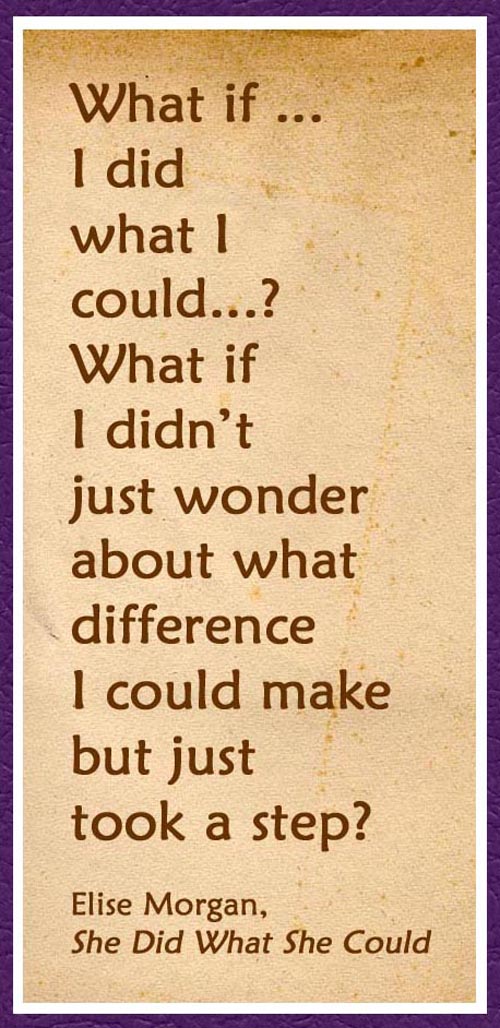
If you read Elisa Morgan’s She Did What She Could: Five Words of Jesus That Will Change Your Life, as well as Kay Warren’s Dangerous Surrender: What Happens When You Say Yes to God, they could inspire you like they did me:

Those two books got me all fired up. All that info went “boin-n-n-ng!” inside my heart, all crashing together, clanging inside my mind and spirit.

To begin with, Kay Warren admits that she sometimes held her fingers over her eyes when she didn’t want to see what was in front of her.

Me, too. How about you?

How many times do I look for a split-second—

  • at the dying child on my TV screen,
  • at the huddled masses at our border, yearning to be free,
  • at the homeless person asking for a job,
  • at the dying refugee propped against a downtown Nairobi building,

and then quickly turn away, as if trying to hold my fingers over my eyes, as if the person’s plight would not really exist if I didn’t look.

But you and I both know that turning away or covering our eyes doesn’t work.

I saw. From that moment on, I knew.

Ever since I moved to Africa and saw what I saw there, I’ve been talking to myself:

Now that I know about 
  • rape as a weapon of war in Democratic Republic of Congo,
  • children sold into slavery and prostitution,
  • the crippling effects of illiteracy,
  • the hopelessness of widespread corruption,
  • AIDS orphans,
  • the incomprehensible suffering of hundreds of thousands around the world,

Now that I know. . .

. . . am I not responsible to do something?

Maybe you are asking the same question Joan Anderson asks:

“What am I meant to do now?

What really matters?

Who am I?”


Elisa Morgan points out Jesus’ words in Mark 14:3,

“She did what she could.”

And then Elisa asks, because God asks,

“What is my ‘what’?” And, “What is your ‘what’?”


Monday, July 22, 2019

Doing great things for God only in the right way and for the right reasons


Much of it spoke to me—even grabbed me—but a little part of it made me uncomfortable. It’s this part in which Sid said:

Do great things for God. . . .

What could God do if every person
who has a relationship with Him
dared to be great?

The thought wasn’t quite developed enough. And what was missing is so important!

Perhaps Sid did explain it but I didn’t remember. In any case, in last week’s blog, I overlooked a crucial ingredient. And this week I discovered what it was, and when I did, it zinged me.

If you and I are to dare to do great things for God, as Sid challenged us to do, we must do it in the right way and for the right reasons.

It’s not about how great you and I are, but how great God is. The greatness comes from Him.

In his devotional, Silent Strength for My Life, Lloyd Ogilvie pointed out that critical missing ingredient I was searching for.

He asks, “What is true greatness and how is it achieved? In the Beatitudes, Jesus gave us the eight-way test of true greatness. He listed the eight character traits He wanted His disciples to possess.

“Jesus called those who have these qualities of greatness ‘blessed.’”

To be blessed “. . . means belonging to God, being his beloved, and knowing you are chosen, called, cherished, and cared for by Him. Blessedness is experiencing unqualified grace. . . .”

Ogilvie says God planned for you and me to “experience the blessedness of the qualities of authentic greatness. . . . We have been designed for greatness according to Christ’s measurements and by His power! Each Beatitude gives us a dimension of that greatness. . . aspects of Christ’s character.” (Lloyd John Ogilvie, Silent Strength for my Life)

So doing great things for God is linked to being blessed by Him—“chosen, called, cherished, and cared for by Him.” You and I can do great things for God only in that context.

Ogilvie writes many pages about living according to the Beatitudes—no simple task—emphasizing that true greatness is based on sincere, authentic human humility.

It’s based on knowing we humans, on our own, don’t have what it takes to do great things for God—those things He wants us to do. That was what I failed to point out last week.

If we want to do great things for God, we must, in all humility, admit our human weaknesses and ask God to help us—and then trust Him to prepare and equip us and then carry out those divine assignments.

Monday, July 15, 2019

Playing life safe for fear God won’t live up to His end of the bargain


Pastor Sid didn’t beat around the bush. He just spoke plainly: “How daring are you?”

His words made me squirm. I don’t like taking risks. I avoid going out on a limb.

Sid was talking about The Parable of the Talents in Matthew 25:14-30 in which a master entrusted his wealth to his servants. “To one he gave five bags of gold, to another two bags, and to another one bag, each according to his ability” (verse 15, NIV). And then the master left them.

Sid was referring to stewardship. We hear that word “stewardship” a lot, but what does it mean?

Stewardship is something we manage or take care of that is not our own.

Like the guys in The Parable of the Talents, God has entrusted you and me with “talents,” things like money, time, skills, and experience. In the parable, the talents were of great value. Treasures. Blessings. Gifts.

Sid told us those “talents,” those blessings, those gifts, are not only for our own use and worldly advancement. The gifts He gave each of us are not just for our own enjoyment and material gain.

No, God’s best for us is this: That we manage our “talents” so they impact God’s work locally and around the world. That’s why He has given us all of those “talents.”

Furthermore, Sid said, the God we know in the Bible doesn’t want us to be conservative in our use of our money, time, skills, and experience.

Whoa. Read that again. God doesn't want us to be conservative in our use of money, time, skills, and experience.

Let’s get back to The Parable of the Talents. When the master returned, the five-talent and the two-talent servants had doubled their holdings.

“What did the two of them do,” Sid asked, “to double their five and two talents? They didn’t play it safe.” 

I don’t know about you but that statement, “they didn’t play it safe,” makes my stomach knot. I always want to play it safe.

Let’s look at the man with only one talent. Instead of investing it, buried it—because, he said, he was afraid.

Today we don’t dare to do great things for God, Sid said, “. . . because we fear God won’t live up to His end of the bargain.”

“. . . because we fear God won’t. . . .”

Won’t what?

Won’t give us strength and tenacity
to do hard things?

Won’t stick with us through the difficult times?

Won’t supply us with what we need along the way?

Sid said:  

The degree of safety that we invest in our lives
 indicates a lack of faith.

Gulp. Lack of faith. Being unwilling to trust God to keep the promises He’s given us in the Bible: His promises to enable us to do what He calls us to do with our talents, His promises to stick with us, to meet our needs (not necessarily wants, but needs) along the way.

It felt like Sid was pointing right at me.

He left us with questions and challenges:

Are you playing it safe with what God has given you of time, money, skills, and past experience?

How much do you trust God? Let go. Invest your “talents” in what God’s doing around the world.

Do you have God-sized dreams and investments?

Or are they too risky? Too scary?

It’s tempting, Sid said, to play it safe and take it easy. He compared life to a ship in the harbor—it’s safe there, but that’s not what ships are for. Staying in the harbor is not what its creator planned for it. What has your Creator planned for you?


Do great things for God.
Trust Him. Don’t settle for playing it safe.

What could God do if every person
who has a relationship with Him
dared to be great?